Equality Act 2010 Training
Practical Equality Act 2010 training covering protected characteristics, discrimination, harassment, victimisation, reasonable adjustments and positive action.
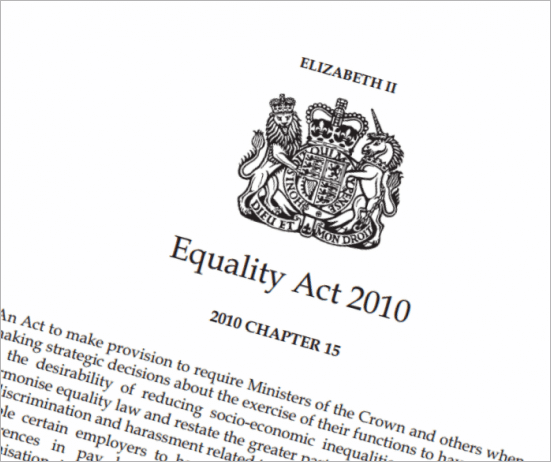
Practical Equality Act 2010 training covering protected characteristics, discrimination, harassment, victimisation, reasonable adjustments and positive action.
The Equality Act 2010 provides the principal legal framework protecting people from discrimination in Great Britain. Understanding the Act helps organisations make fairer decisions, respond appropriately to concerns and translate legal duties into everyday workplace and service practice.
Equality law can appear complex when it is taught simply as a collection of legal definitions.
This course uses practical examples and scenarios to help delegates understand what the Equality Act means for decisions, behaviour, policies, employment and service delivery.
In‑house courses are private sessions delivered exclusively for a group of people from your organisation, on a date that suits you, with the option to tailor the content to your staff and setting.
Open courses are public Equality and Diversity UK training dates that anyone can book onto, ideal when you only need training for one or two people.
Delegates explore the nine protected characteristics within the Equality Act 2010:
The course also considers why knowing the list is only the beginning. Different protections apply in different contexts, and effective practice requires delegates to understand how discrimination can actually arise.
Equality Act 2010 Training is suitable for managers, employees, HR and People teams, EDI leads and champions, senior leaders, educators, service providers, local authorities, charities, voluntary organisations and other public or private-sector organisations.
No previous legal knowledge is required. Content can be adapted for introductory staff awareness or for managers and professionals who need a more detailed practical understanding.
Direct discrimination concerns less favourable treatment because of a protected characteristic in circumstances covered by the Act.
Indirect discrimination can be less obvious. An apparently neutral provision, criterion or practice may disadvantage people sharing a protected characteristic and require objective justification.
Delegates work through practical examples to distinguish these concepts and consider how organisational decisions can create unintended inequality.
The programme explores relevant Equality Act concepts of harassment and victimisation and helps delegates distinguish these from the broader everyday meanings of the words.
This is particularly useful for managers who may need to receive concerns, challenge inappropriate behaviour or understand why retaliation against somebody who raises an equality concern can create additional risk.
Build practical understanding of key Equality Act protections and concepts.
Recognise discrimination and equality risks in realistic organisational situations.
Translate legal principles into fairer decisions, behaviour and workplace practice.
Disability has additional provisions within the Equality Act. Delegates explore disability discrimination and the duty to make reasonable adjustments in relevant circumstances.
The course considers how physical environments, policies, working arrangements, communication methods and other aspects of employment or service delivery may create disadvantage.
The emphasis is on identifying barriers and considering appropriate responses rather than assuming everybody with the same impairment requires the same adjustment.
Delegates are introduced to discrimination arising from disability and why treating somebody unfavourably because of something arising in consequence of disability can raise different issues from direct discrimination.
Practical scenarios help managers consider absence, performance, conduct, communication and other situations where disability may be relevant.
Equality does not always mean treating everybody identically. The Equality Act contains provisions allowing positive action in defined circumstances.
Delegates explore the distinction between lawful positive action and unlawful positive discrimination, helping organisations think more confidently about proportionate measures designed to address disadvantage or underrepresentation.
One of the most useful practical lessons from equality law is that fairness does not always require everybody to be treated in precisely the same way.
Reasonable adjustments, pregnancy and maternity protections and lawful positive action all demonstrate why organisations need to understand relevant differences rather than relying on a simplistic idea that equality means identical treatment.
Equality considerations can arise throughout employment: recruitment, selection, promotion, training, performance, absence, flexible working, disciplinary processes, redundancy and dismissal.
Delegates consider how clear criteria, evidence, consistency and awareness of reasonable adjustments can reduce discrimination risk and support better decisions.
Equality Act protection is not always limited to somebody personally having a particular protected characteristic. Depending on the form of discrimination, association or perception can also be relevant.
The course uses practical examples to explain these principles without expecting delegates to become lawyers.
Where relevant to the organisation, the programme can cover the Public Sector Equality Duty and the need for public authorities and organisations exercising relevant public functions to have due regard to the statutory equality aims.
This can be linked to decision-making, policy development and Equality Impact Assessment where appropriate.
Legal compliance is only part of inclusion. Organisations can set standards of respectful behaviour that go beyond the minimum threshold for unlawful discrimination.
Delegates explore inappropriate language, stereotypes, assumptions and subtle exclusion, while recognising that not every poor workplace interaction automatically constitutes unlawful discrimination.
By the end of the course, delegates should be better able to:
Legal concepts are explored through practical examples, case studies and discussion. This helps delegates move beyond memorising terminology and consider how equality law applies to situations they may genuinely encounter.
In-house delivery enables the course to reflect your sector, workforce, service users, policies and the equality situations delegates are most likely to encounter.
All our courses are tailored to ensure the training reflects your organisation's goals, equality responsibilities and priorities.
The course can be delivered face-to-face or online via Zoom or Teams.
To support participation, discussion and interaction, we recommend the following group sizes per session:
Need to train a larger workforce? No problem. We regularly work with organisations that need to train larger numbers of employees. Where appropriate, training can be delivered across multiple sessions to ensure everyone receives the same high-quality, interactive learning experience. We can develop a delivery programme to suit your workforce size, locations and timescales.
Please note: the half-day rate is not always available for face-to-face sessions.
Over 25 years' experience delivering equality, diversity and inclusion training, consultancy and professional development.
Keep updated with the latest equality and diversity news, offers and updates.